Most of the questions we ask each other exist precisely to not get an answer. "How was your weekend?" isn't interest, it's a door handle. You grab it to pass through, not to stop.
That's exactly the problem with most question games, icebreaker apps and conversation cards: they stay polite. And polite means you learn nothing. Not about the other person, and not about yourself.
oof. turns that around. It's a question game with three intensities — and it works in two directions: loud, with one person or a group, until someone gets honest. And quiet, alone, as self-reflection at two a.m.
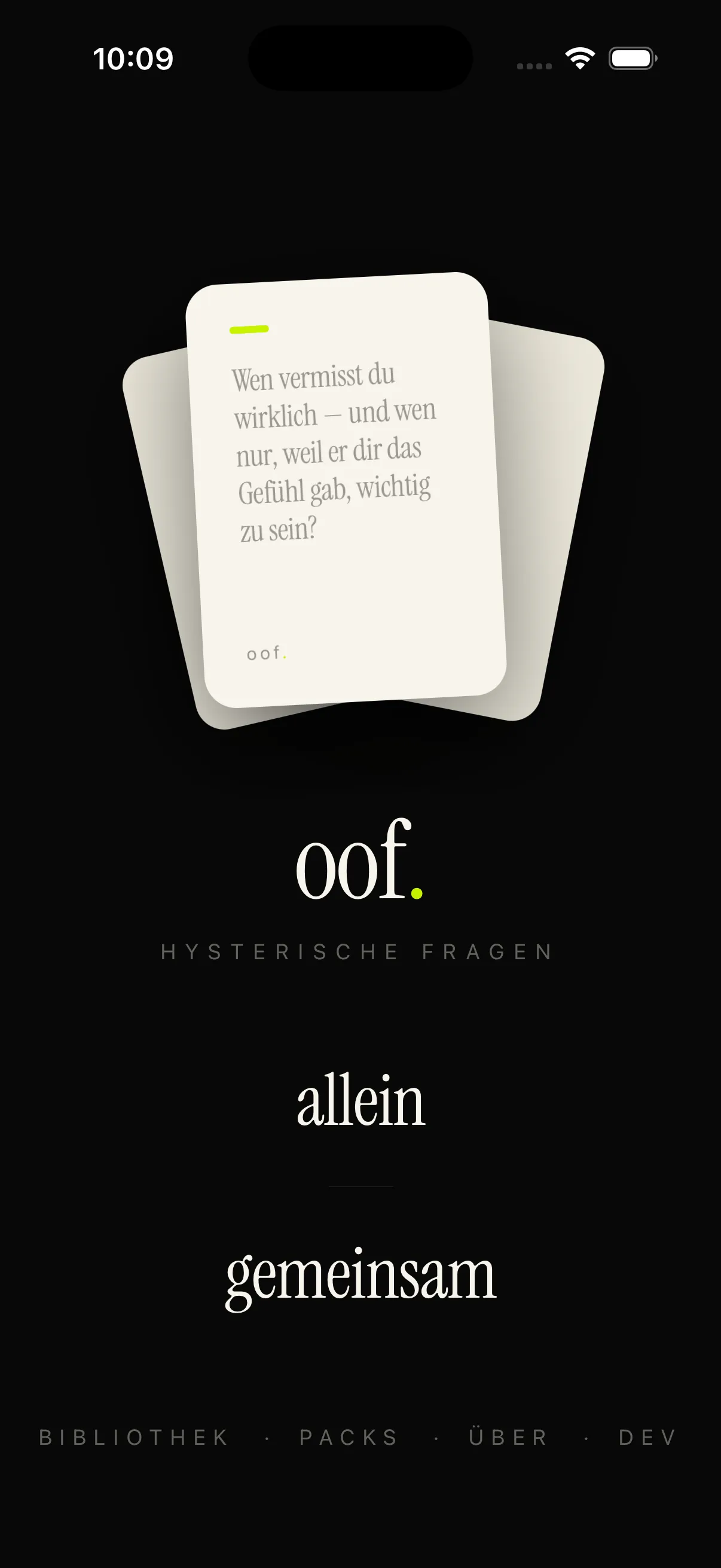
Together: honest questions that are actually fun
The obvious mode: an evening, a few people, oof. in the middle. It's a good game with friends because it doesn't try to be a "fun party game" while staying harmless. It's funny because it isn't harmless.
For couples it works as what relationship questions should be and rarely are: not the magazine questionnaire, but the one card that makes you go quiet for a moment and then talk for two hours. For a group that already knows each other, it's the point where "knowing" suddenly feels like a claim.
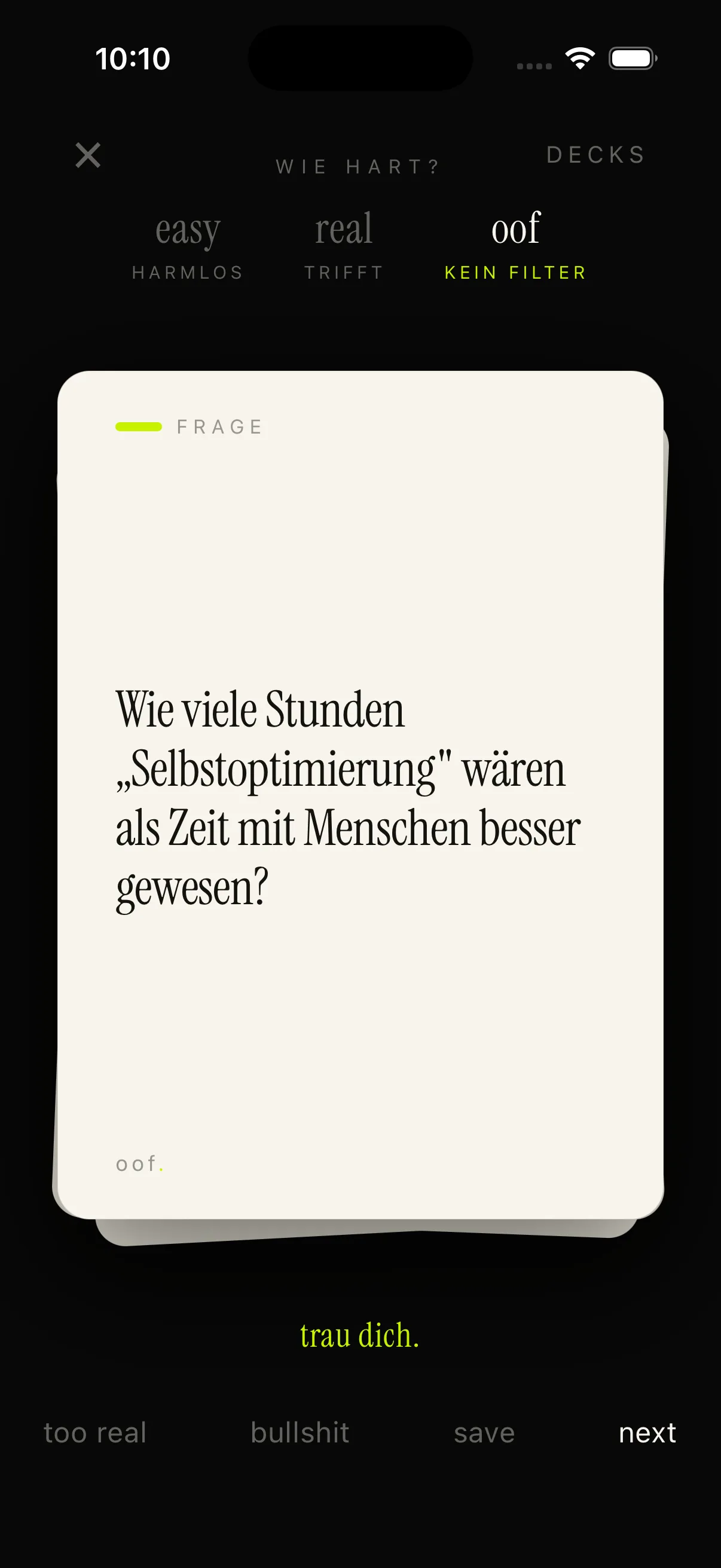
There are no points, no winner, no rounds. One question, one answer, next. That sounds like very little and is exactly right — the mechanics mustn't get in the way when the questions do the work.
Alone: the same cards for self-reflection
Here oof. becomes something else. The same cards, no one at the table, no audience for the answer. That's the difference between an answer that sounds good and one that's true.
For most people, self-reflection fails not on willpower but on material. "Reflect on yourself" isn't a task, it's a blank page. What works is concrete, uncomfortable questions to think about — one after another, without anyone telling you what you're supposed to feel.
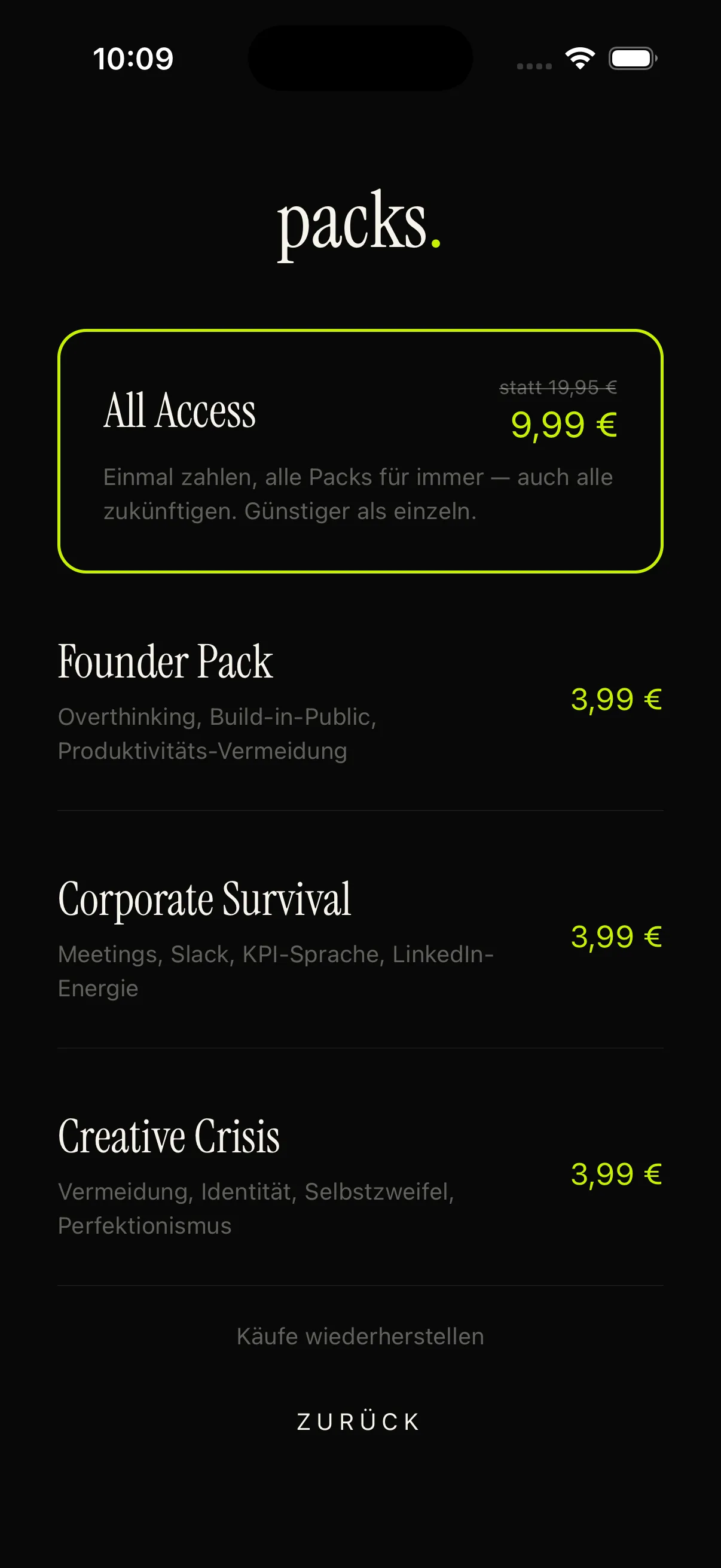
The solo mode has its own minimal mechanic: one question, no one watching. You read it and answer it for real — in your head is fine, dishonestly is not. If it lands: too real. If it misses: bullshit. If it fits: save. Then the next one. No analysis, no score, no streak.
That's exactly the dual use that separates oof. from a mere game: deep questions that get the laugh and the silence afterward in a group are, alone, the most honest reflection questions you can get — because no one is listening and you don't have to talk yourself into a nicer answer.
Three intensities: easy, real, oof
The mechanism behind it is a single slider, switchable mid-game:
- →easy — harmless. For warming up, or when the group isn't there yet.
- →real — lands. Personal questions you normally wouldn't ask.
- →oof — no filter. The questions that go too far. That's exactly why the app is called that.
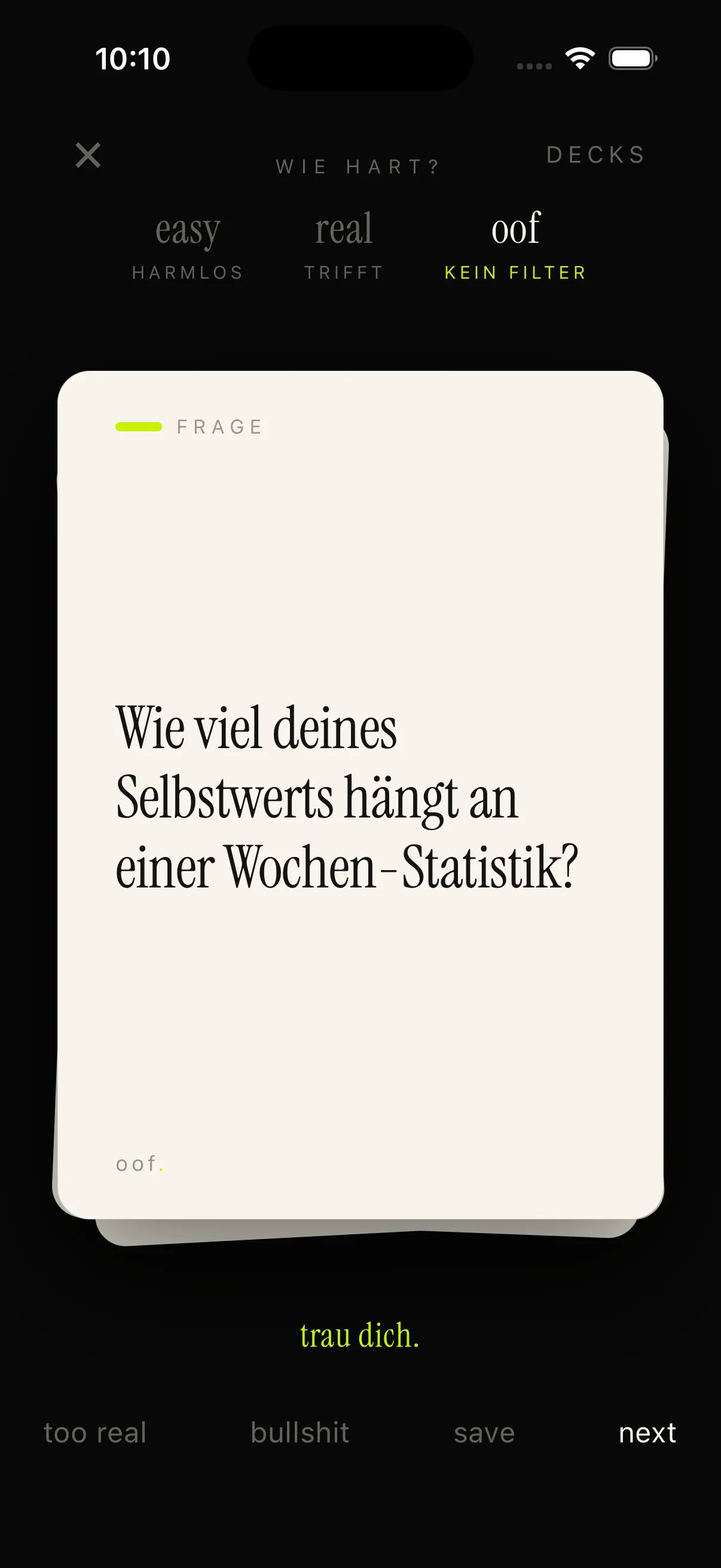
That's why the same deck can be both a game night and a quiet half hour. You're not shifting the topic, you're shifting the depth.
Sample questions: how the oof intensity feels
So it's clear what "no filter" concretely means — a few real cards from the game. These aren't small-talk questions and they aren't quiz questions, they're questions to think about that trigger a laugh and then silence in a group — and, alone as self-reflection, honestly hurt:
What does your full calendar protect you from, if you're completely honest?
Which rule do you secretly break that you preach to others?
What's your answer to "why do you do this?" that isn't entirely honest?
How many pairs of running shoes do you actually "need"?
On easy the same themes are wrapped harmlessly, on real they land, on oof they know no filter. You decide per round how uncomfortable it's allowed to get.
Five decks, 600 questions — buy once, no subscription
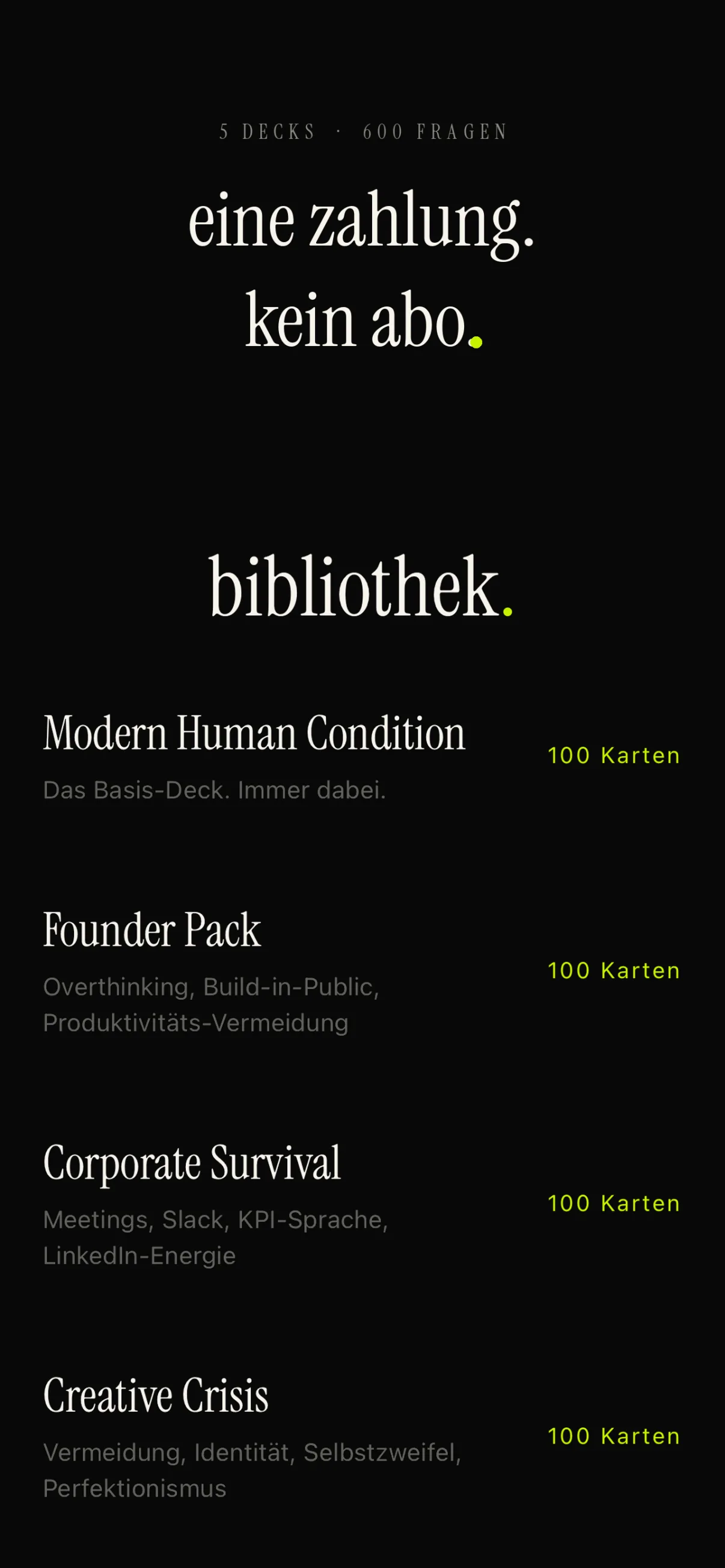
The free scope isn't stingy: the base deck Modern Human Condition with 100 questions is always included and free. Premium is a one-time purchase — no subscription, no lootbox logic — and unlocks the full library: five decks with 600 questions total, each with its own focus:
- →Modern Human Condition — the base deck, always included.
- →Founder Pack — overthinking, build-in-public, productivity avoidance.
- →Corporate Survival — meetings, Slack, KPI language, LinkedIn energy.
- →Creative Crisis — avoidance, identity, self-doubt, perfectionism.
The library keeps growing. Which deck fits you depends on what you're currently trying not to think about.
No account, no tracking, everything stays on the device
An app you think your most honest answers into has no business collecting data. oof. has no account, no tracking, no cloud. Everything stays on the device. There's nothing to sync, because there's nothing that belongs anywhere else.
oof. is an adults' card game (17+) and currently available in Germany, Austria and Switzerland — for iPhone on the App Store and for Android on Google Play.
Frequently asked questions about oof.
Is oof. free?
Yes, with the base deck: 100 questions ("Modern Human Condition") are free forever. If you want more, you buy Premium once — five decks, 600 questions, no subscription.
What kind of questions are in oof.?
Three intensities: easy (harmless), real (lands), oof (no filter). They're deep, often uncomfortable questions to think about — not quiz or small-talk questions. Examples are above in the article.
Can you use oof. alone for self-reflection?
Yes. Alongside the shared mode there's a solo mode: the same cards, no one watching — quiet self-reflection with no analysis, no streak, no account.
Does oof. need an account or internet?
No. No account, no tracking, no cloud — everything stays on the device.
In which countries and on which devices is oof. available?
Currently in Germany, Austria and Switzerland — for iPhone on the App Store and for Android on Google Play.
If your questions are already door handles: there's an app that stops where you'd usually pass through. Get oof. — App Store · Google Play.