Open your MacBook in the morning and, before you've typed a thing, it has already talked to dozens of servers. Some you'd expect: iCloud, your mail, the browser tab you left open. Many you wouldn't: analytics endpoints, telemetry, ad networks, a handful of companies you've never heard of, in countries you never picked. You can't see any of it. That gap stuck with me the whole time I was building NetMute, and version 2.1 closes it.
I build NetMute myself. It's a per-app firewall for macOS: you decide which apps get to reach the internet. But blocking is only half the story. The other half is the one nobody shows you: where your data actually goes. So I built that.

A world map, drawn on your Mac
Open Reports and there's a new card: a world map with each country shaded by how much your apps sent there. Tap a country and it expands to show which apps are talking to it, ranked by volume. Servers in Ireland? Mostly Apple and Meta. The US lighting up? Your browser and a stack of analytics companies. Once you've seen it, you can't unsee it.
What matters is how the map is made. It comes from a country database I put together myself from the public regional-registry files, the same data behind the internet's address allocation. It ships inside the app at around 2.5 MB. There's no third-party geolocation SDK, no online lookup, nothing phoned out to draw it. Checking where your Mac connects shouldn't leak where you are.
Cryptic hostnames, made readable
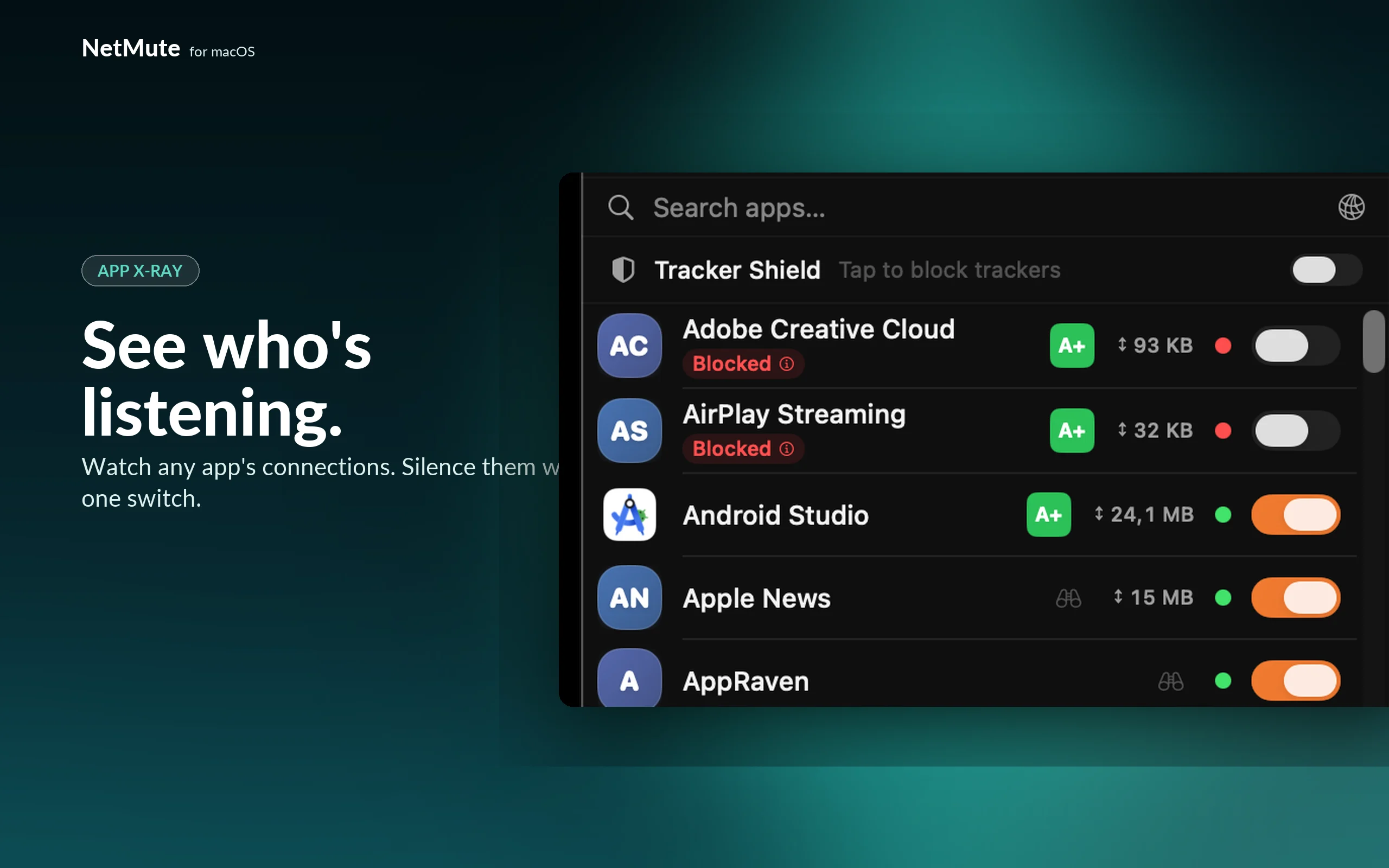
The other thing 2.1 fixes: connections used to look like rr4---sn-xyz.googlevideo.com. App X-Ray now translates that to YouTube, with the server's country flag and exactly how much was sent and received. fbcdn.net becomes Facebook / Instagram, scdn.co becomes Spotify. You end up with a sentence you can actually read: this app talked to YouTube in the Netherlands and pulled 2.3 GB.
What it sees, and what it can't
This is the line I care about most. A privacy tool that quietly crosses it is worthless.
NetMute sees where a connection goes and how much moved. It does not see what's inside, and it can't. Each app encrypts its data before it ever reaches the filter, so what passes through is sealed. "YouTube, Netherlands, 2.3 GB" is the whole truth. Which video, which page, which search stays in the encrypted part, unreadable to NetMute by design.
I'm not apologizing for that. It's the promise: NetMute sees the address on the envelope and the postage, never the letter.
Also new in 2.1
- →A Today view in Reports, plus sent and received shown separately and usage per network, so you can tell your home Wi-Fi from your phone's hotspot.
- →Data limits that hold: per app or for the whole Mac. The count survives a reboot, and you can add a hard stop.
- →Seeing is free, acting is Pro: the Privacy Dashboard, App X-Ray and Reports are now open to everyone. You see all of it. Blocking trackers system-wide stays Pro.
NetMute is a small indie app with no account, no cloud and a one-time price, made by one person. With 2.1 it doesn't just block the noise. It shows you what the noise looks like.
Guides, comparisons and everything else about NetMute live on netmute.com and on the app page.